
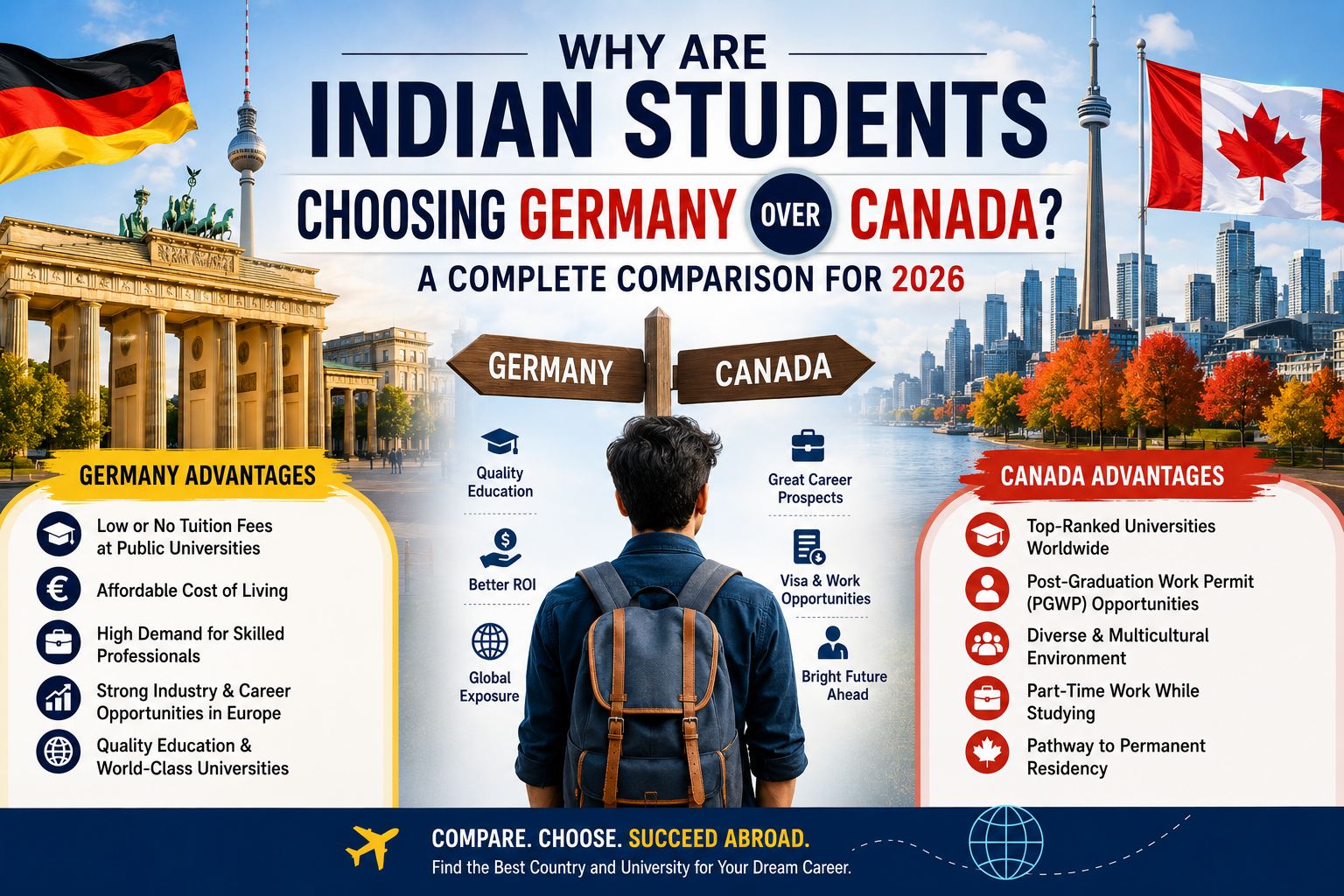
Yes, Germany is becoming an increasingly attractive alternative to Canada for Indian students, particularly for students who prioritise affordable education, strong career opportunities, and lower overall study costs. Germany's public universities often have little or no tuition fees, while Canada's international tuition can be substantially higher. At the same time, recent reporting indicates that Canadian student demand has been affected by tighter visa and immigration policies, while interest in European destinations is growing among Indian students. However, Canada remains an excellent option for students who prioritise English-medium education and its established post-study work system.
Why are Indian students increasingly considering Germany?
One of the biggest reasons is cost. Germany offers many public university programmes with no general tuition fee, although students still pay semester contributions and some states or universities have exceptions. Canada, on the other hand, has significantly higher international tuition fees. Official Canadian figures put average 2025/26 tuition at about CAD 41,746 per year for international undergraduate students and CAD 24,028 for graduate students, before living expenses.
For students and families managing education loans, this difference can have a major impact on the overall return on investment.
Is Germany cheaper than Canada for international students?
Yes, in many cases. Germany can be considerably more affordable, especially when a student secures a place at a public university without tuition charges.
However, "free education" does not mean studying in Germany is completely free. Students still need money for accommodation, food, insurance, transportation, semester contributions, and other expenses. Germany also requires students to demonstrate sufficient financial resources for their stay; the German authorities currently specify €11,904 for one year for the relevant student-visa financial requirement.
Is Germany better than Canada for students looking for affordable education?
For affordability, Germany often has the advantage. Students can find high-quality programmes at public universities without the large tuition bills associated with many Canadian institutions.
This makes Germany particularly attractive to Indian students who want to reduce their dependence on education loans and keep the total cost of an international degree manageable.
Is Canada still a good option for Indian students?
Yes. Canada continues to offer high-quality universities, English-language programmes, multicultural communities, and opportunities to gain international work experience.
However, Canada's international education environment has changed. Recent reports indicate that stricter and less predictable visa and immigration policies have contributed to declining international enrolment in some areas.
Therefore, students should not choose Canada solely because it was historically popular among Indian students. They should evaluate the current programme, tuition, study-permit requirements, work options, and career outcomes.
Are German universities good for Indian students?
Yes. Germany is particularly attractive for students interested in Engineering, Computer Science, Artificial Intelligence, Data Science, Cybersecurity, Automotive Engineering, Mechanical Engineering, Renewable Energy, and Business-related fields.
Germany's strong industrial base also provides opportunities to connect academic learning with real-world applications through internships, research projects, and industry collaborations.
Does Germany offer courses in English?
Yes. Many German universities offer English-taught master's programmes, particularly in technology, engineering, business, and science.
For bachelor's programmes, German-taught courses are more common, so students should carefully check the language requirements of each university and programme before applying.
Is English enough to work in Germany after graduation?
Not always. Students can study many programmes in English, but learning German can significantly improve their opportunities for internships, part-time jobs, networking, and employment.
For students planning a long-term career in Germany, learning German alongside their degree can therefore be a major advantage.
Which country has better post-study opportunities?
Both countries offer opportunities, but the systems are different.
Germany provides eligible graduates with a residence period to look for qualified employment after completing their studies. Canada offers the Post-Graduation Work Permit (PGWP) to eligible graduates, with the length depending on the programme and applicable rules.
Students should check the latest official immigration requirements before making a decision because post-study work rules can change.
Why are visa policies influencing student decisions?
Visa certainty has become increasingly important to Indian students and their families. Recent reporting shows that Canada's tighter immigration and visa environment has affected demand in parts of its international education sector.
Germany also has specific documentation requirements for Indian students. For example, students applying for many German degree programmes requiring an APS certificate generally apply through the designated visa process in India.
The key lesson is that students should compare current visa requirements, rather than relying on older perceptions of either country.
Which country is better for STEM students?
Germany can be particularly attractive for STEM students. The country has a strong reputation in engineering, manufacturing, automotive technology, computer science, AI, robotics, and industrial research.
Canada also has strong STEM universities and technology companies, so the best choice depends on the specific course, university, budget, and career target.
Is Germany better than Canada for Indian students in 2026?
Germany may be the better option for students whose priorities are affordable tuition, STEM education, and European career opportunities. Canada may be preferable for students who strongly value English-only education, an established Indian community, and Canada's post-study work system.
There is no universal winner. The right choice depends on the student's course, university, budget, language preference, career plans, and immigration goals.
What should Indian students compare before choosing Germany or Canada?
Students should compare:
- Tuition fees
- Living expenses
- University ranking and course quality
- English-taught programmes
- Scholarship opportunities
- Student visa requirements
- Part-time work rules
- Post-study work options
- Job opportunities
- Language requirements
- Long-term career goals
Looking only at tuition fees or PR possibilities can lead to the wrong decision.
Germany vs Canada: Which country offers better value?
Factor | Germany 🇩🇪 | Canada 🇨🇦 |
|---|---|---|
Public university tuition | Often low/no general tuition, with exceptions | Generally higher for international students |
English-taught programmes | Many, especially master's | Widely available |
STEM opportunities | Excellent | Excellent |
Living costs | Vary by city | Vary by city |
Local language | German can help significantly | English widely used |
Post-study pathway | Job-search residence available to eligible graduates | PGWP available to eligible graduates |
Industry strength | Engineering, automotive, manufacturing, technology | Technology, finance, healthcare, engineering |
Best suited for | Students focused on affordability and European careers | Students prioritising English-medium education and Canadian work experience |
Canada's official education portal notes that tuition varies substantially by programme, school, and location, so students should always calculate costs for their specific university rather than relying on country-level averages.
Is the Germany vs Canada decision changing in 2026?
Yes. The study-abroad decision among Indian students is becoming more focused on value, affordability, employability, and realistic career outcomes. Recent reporting suggests that the broader Indian study-abroad market itself has softened, with students and families becoming more cautious about the return they can expect from an overseas degree.
This makes destinations such as Germany particularly interesting for students seeking a lower-cost pathway to an internationally recognised education.
Final Answer
Yes, Germany is increasingly becoming a strong alternative to Canada for Indian students in 2026, especially for those looking for affordable education, STEM-focused programmes, strong industries, and European career opportunities. Germany's public-university model can significantly reduce tuition costs, while Canada's international tuition and changing immigration environment are encouraging some students to explore alternatives.
However, Canada remains a strong study destination. The best choice is not simply Germany vs Canada—it is about finding the right country, course, university, budget, and career pathway for each student.
Norvel helps students compare countries and courses, discover suitable universities, understand costs, and find study-abroad options based on their academic profile and career goals.
Blog Prepared By,
Jerin Francis
CEO & Abroad Study Advisor
Norvel Technologies Pvt Ltd