
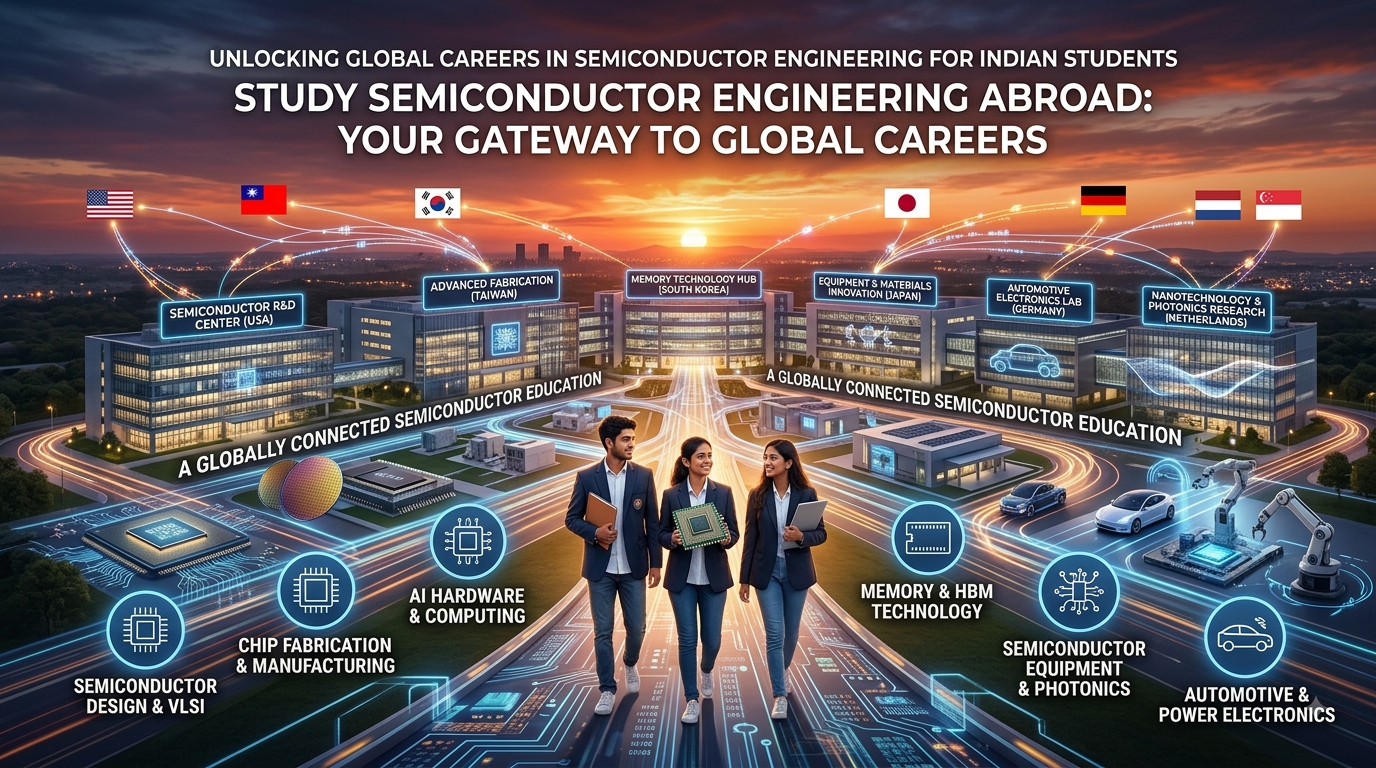
The USA, Taiwan, South Korea, Japan, Germany, the Netherlands, and Singapore are among the strongest destinations for Semiconductor and Electronics Engineering. Each country has a different advantage: Taiwan and South Korea are particularly strong in chip manufacturing, the USA in chip design and advanced research, Japan in semiconductor equipment and electronics, Germany in automotive and industrial electronics, and the Netherlands in semiconductor manufacturing equipment.
For Indian students, this field is becoming increasingly attractive because semiconductors are essential to artificial intelligence, electric vehicles, smartphones, data centres, robotics, telecommunications, aerospace, and consumer electronics.
Why should Indian students study Semiconductor Engineering abroad?
Semiconductor Engineering is becoming an increasingly important career field. The global semiconductor industry covers much more than chip manufacturing. It includes research, chip design, fabrication, packaging, testing, semiconductor equipment, materials, and electronics systems.
The rapid growth of AI and advanced computing is also increasing demand for semiconductors. Industry analysis for 2026 identifies the USA, China, South Korea, and Taiwan among the regions expected to experience particularly strong semiconductor growth, while Europe and Japan continue developing their positions in automotive and industrial semiconductor applications.
Students can therefore build careers in areas such as:
- Semiconductor design
- VLSI
- Microelectronics
- Embedded systems
- Nanoelectronics
- Chip fabrication
- Semiconductor manufacturing
- Electronics engineering
- Photonics
- Integrated circuits
- Semiconductor testing
- Power electronics
Which countries are best for Semiconductor and Electronics Engineering?
The leading destinations include:
- 🇺🇸 USA
- 🇹🇼 Taiwan
- 🇰🇷 South Korea
- 🇯🇵 Japan
- 🇩🇪 Germany
- 🇳🇱 Netherlands
- 🇸🇬 Singapore
- 🇫🇷 France
- 🇬🇧 UK
- 🇮🇱 Israel
However, the "best" country depends on whether you want to specialise in chip design, fabrication, electronics, semiconductor equipment, automotive electronics, or research.
Is the USA a good destination for Semiconductor Engineering?
Yes. The USA is one of the strongest destinations for semiconductor research, chip design, computing, and advanced electronics.
The country's semiconductor ecosystem includes major technology companies, chip designers, equipment manufacturers, research institutions, and universities.
The USA is particularly attractive for students interested in:
- VLSI Design
- Semiconductor Devices
- Computer Engineering
- Microelectronics
- Integrated Circuit Design
- AI Hardware
- Photonics
- Advanced Semiconductor Research
The USA also has substantial research activity. The 2026 U.S. National Science Foundation report shows the United States among the world's major performers in semiconductor-related research and technology development. (NCSES)
Why choose the USA?
- Strong semiconductor R&D
- Advanced university laboratories
- Major technology ecosystem
- Strong chip-design industry
- Research opportunities
- High-level electronics and computing careers
Best for: Chip design, semiconductor research, AI hardware and advanced electronics.
Is Taiwan the best country for semiconductor manufacturing?
Taiwan is one of the world's most important semiconductor manufacturing hubs.
Taiwan is home to TSMC and has a highly developed semiconductor supply chain. Industry data indicates that Taiwan has an exceptionally strong position in advanced chip fabrication.
Students interested in semiconductor manufacturing can explore:
- Semiconductor fabrication
- IC manufacturing
- VLSI
- Nanoelectronics
- Semiconductor process engineering
- Advanced packaging
- Chip design
Taiwan's ecosystem provides exposure to one of the most concentrated semiconductor manufacturing environments in the world.
Best for: Semiconductor fabrication, manufacturing, IC technology and advanced chips.
Why is South Korea a major semiconductor destination?
South Korea is one of the world's leading semiconductor countries, particularly in memory chips and advanced semiconductor manufacturing.
The country's semiconductor industry is a major driver of exports and investment. In 2025, South Korean semiconductor exports reached a record level, while government support has continued to target semiconductor clusters, advanced packaging, materials, equipment and talent development.
Major areas include:
- Memory semiconductors
- AI chips
- High-bandwidth memory
- Semiconductor manufacturing
- Electronics
- Display technology
- Advanced packaging
South Korea is particularly relevant for students interested in memory technology and high-performance computing hardware.
Best for: Memory chips, advanced manufacturing, AI semiconductor technology and electronics.
Is Japan good for Electronics and Semiconductor Engineering?
Yes. Japan has a long history in electronics and semiconductor technology.
Japanese companies and research institutions are active in semiconductor equipment, materials, electronics, sensors, automotive technology, and advanced manufacturing.
Japan is especially attractive for students interested in:
- Electronics
- Robotics
- Semiconductor materials
- Semiconductor equipment
- Automotive electronics
- Sensors
- Embedded systems
- Manufacturing technology
Japan, alongside the USA, Germany and the Netherlands, is an important contributor to semiconductor manufacturing equipment. (GTAI)
Best for: Electronics, robotics, semiconductor equipment, sensors and manufacturing.
Why should students consider Germany?
Germany is an excellent choice for students interested in semiconductor engineering combined with automotive and industrial technology.
Germany has a significant semiconductor ecosystem, particularly in power semiconductors, optical semiconductors, sensors and semiconductor manufacturing equipment.
This makes Germany particularly interesting for students who want to combine semiconductor knowledge with:
- Automotive engineering
- Industrial automation
- Electrical engineering
- Embedded systems
- Power electronics
- Renewable energy
- Robotics
Germany is also attractive to Indian students because many public universities offer relatively affordable study options, although tuition and fees vary by university, programme and state.
Best for: Automotive electronics, power semiconductors, industrial electronics and engineering.
Is the Netherlands good for Semiconductor Engineering?
Yes. The Netherlands is one of Europe's most important semiconductor technology hubs.
Its major strength is semiconductor manufacturing equipment. The Dutch government's 2026 Semiconductor Vision states that the Netherlands ranks among the top three countries globally in semiconductor manufacturing equipment.
This creates opportunities in:
- Semiconductor equipment
- Microelectronics
- Photonics
- Nanotechnology
- Chip manufacturing technology
- Electrical engineering
- High-tech systems
The Netherlands is therefore an excellent choice for students interested in the technology behind semiconductor manufacturing, rather than only chip fabrication.
Best for: Semiconductor equipment, photonics, nanotechnology and high-tech systems.
Is Singapore a good destination for Electronics Engineering?
Yes. Singapore has a strong electronics and semiconductor manufacturing ecosystem.
The country is an important electronics manufacturing and semiconductor hub in Asia and can be attractive for students interested in:
- Semiconductor manufacturing
- Electronics
- Integrated circuits
- Advanced manufacturing
- Automation
- Electrical engineering
- Supply-chain technology
Singapore can also be attractive for students who want to study in an international English-speaking environment.
Best for: Semiconductor manufacturing, electronics and advanced manufacturing.
Is France suitable for Semiconductor Engineering?
Yes. France has a significant electronics and semiconductor ecosystem, particularly in research, power electronics, embedded systems and industrial technology.
Students can explore areas such as:
- Microelectronics
- Embedded systems
- Electronics
- Semiconductor devices
- Photonics
- Electrical engineering
- Power electronics
France can be especially interesting for students who want to combine electronics with aerospace, automotive, telecommunications or industrial technology.
Is the UK a good option for semiconductor studies?
Yes. The UK is a strong option for semiconductor research, electronics, photonics and chip design.
Students can explore:
- Semiconductor devices
- Electronic engineering
- Microelectronics
- Photonics
- Integrated circuit design
- Quantum technologies
- Advanced materials
The UK can be particularly attractive for students looking for research-intensive master's and doctoral programmes.
Which country is best for chip design?
For chip design and advanced semiconductor research, students can consider:
- USA
- Taiwan
- South Korea
- UK
- Netherlands
- Japan
The USA is particularly strong in semiconductor design and advanced computing, while Taiwan and South Korea combine design capabilities with major manufacturing ecosystems.
Which country is best for semiconductor manufacturing?
For manufacturing and fabrication, strong choices include:
Taiwan: Advanced logic-chip fabrication.
South Korea: Memory and advanced semiconductor manufacturing.
Japan: Manufacturing, materials and semiconductor equipment.
USA: Advanced manufacturing, design and research.
Germany: Automotive, power and industrial semiconductors.
Singapore: Semiconductor manufacturing and electronics.
Taiwan and South Korea remain especially important in global semiconductor manufacturing.
Which country is best for Electronics Engineering?
There is no single answer.
Country | Major Strength | Best For |
|---|---|---|
🇺🇸 USA | Chip design & research | AI chips, VLSI, semiconductor R&D |
🇹🇼 Taiwan | Chip fabrication | Semiconductor manufacturing |
🇰🇷 South Korea | Memory & advanced chips | HBM, memory, manufacturing |
🇯🇵 Japan | Electronics & equipment | Robotics, sensors, manufacturing |
🇩🇪 Germany | Automotive & industrial electronics | Power electronics, automotive |
🇳🇱 Netherlands | Semiconductor equipment | Photonics, nanotechnology |
🇸🇬 Singapore | Manufacturing & electronics | Semiconductor production |
🇫🇷 France | Research & industrial electronics | Microelectronics, aerospace |
🇬🇧 UK | Research & chip design | Microelectronics, photonics |
🇮🇱 Israel | Chip design & technology | Semiconductors, electronics, R&D |
What courses can students study?
Indian students can choose from several related degrees.
Bachelor's programmes
- Bachelor of Electronics Engineering
- Bachelor of Electrical Engineering
- Bachelor of Electronics and Communication Engineering
- Bachelor of Microelectronics
- Bachelor of Computer Engineering
- Bachelor of Semiconductor Engineering
Master's programmes
- MSc Semiconductor Engineering
- MSc Microelectronics
- MSc Electronics Engineering
- MSc VLSI Design
- MSc Electrical Engineering
- MSc Nanoelectronics
- MSc Integrated Circuit Design
- MSc Photonics
- MSc Embedded Systems
The exact programme title differs between universities, so students should search for related specialisations rather than only the phrase "Semiconductor Engineering."
What are the admission requirements?
For Bachelor's programmes
Students typically need:
- Class 12 qualification
- Mathematics
- Physics
- Strong academic performance
- English-language proficiency where required
- University-specific admission requirements
For Master's programmes
Students generally need:
- Bachelor's degree in Electrical Engineering, Electronics, Electronics and Communication, Computer Engineering, Physics or a related field
- Academic transcripts
- Statement of Purpose
- English-language proficiency where required
- Letters of recommendation where applicable
- Relevant technical background
Some specialised programmes may require knowledge of circuits, semiconductor physics, electronics, programming or mathematics.
What careers can Semiconductor Engineering graduates pursue?
Graduates can work in a wide range of technical roles.
Semiconductor careers
- Semiconductor Engineer
- Process Engineer
- Semiconductor Device Engineer
- IC Design Engineer
- VLSI Engineer
- Verification Engineer
- Test Engineer
- Yield Engineer
- Packaging Engineer
Electronics careers
- Electronics Engineer
- Embedded Systems Engineer
- Hardware Engineer
- PCB Design Engineer
- Power Electronics Engineer
- Systems Engineer
- Electronics Researcher
Emerging areas
- AI Hardware Engineer
- Photonics Engineer
- Quantum Hardware Researcher
- Automotive Electronics Engineer
- Chip Architect
- Advanced Packaging Engineer
Which industries hire semiconductor engineers?
Semiconductor graduates can work across:
- Artificial Intelligence
- Consumer electronics
- Automotive
- Electric vehicles
- Telecommunications
- Aerospace
- Defence
- Robotics
- Data centres
- Renewable energy
- Medical technology
- Industrial automation
The semiconductor industry is also closely connected to AI and advanced computing. The 2026 semiconductor outlook highlights AI processors, high-bandwidth memory and electrification as important growth drivers. (TechInsights)
Is Semiconductor Engineering a good career for the future?
Yes. Semiconductor Engineering is a promising field for students interested in electronics, computing and advanced technology.
Modern technologies such as AI, electric vehicles, smartphones, robotics, cloud computing, telecommunications and autonomous systems all depend on semiconductor technology.
The global industry is also becoming strategically important. Current research shows that no single country controls the entire advanced-semiconductor supply chain, with different countries specialising in design, manufacturing, equipment, materials, packaging and other stages. (Belfer Center)
This means students can build careers in different parts of the semiconductor ecosystem.
Which country should Indian students choose?
The answer depends on your specialisation.
Choose the USA if you are interested in chip design, AI hardware and advanced research.
Choose Taiwan if your priority is semiconductor fabrication and manufacturing.
Choose South Korea if you are interested in memory chips, HBM and advanced semiconductor manufacturing.
Choose Japan for electronics, robotics, sensors and manufacturing technology.
Choose Germany for automotive electronics, power semiconductors and industrial technology.
Choose the Netherlands for semiconductor equipment, photonics and nanotechnology.
Choose Singapore for semiconductor manufacturing and electronics.
Choose France or the UK for research, microelectronics and specialised engineering programmes.
Final Takeaway
Semiconductor and Electronics Engineering is becoming one of the most strategically important technology fields for the future. For Indian students, countries such as the USA, Taiwan, South Korea, Japan, Germany, the Netherlands and Singapore provide different pathways into the global semiconductor ecosystem.
The best destination isn't necessarily the country producing the most chips. Students should identify whether they want to work in chip design, fabrication, semiconductor equipment, electronics, testing, packaging, automotive technology, or research and then select the country and university that best matches that goal.
Blog Prepared By,
Jerin Francis
CEO & Abroad Study Advisor
Norvel Technologies Pvt Ltd