
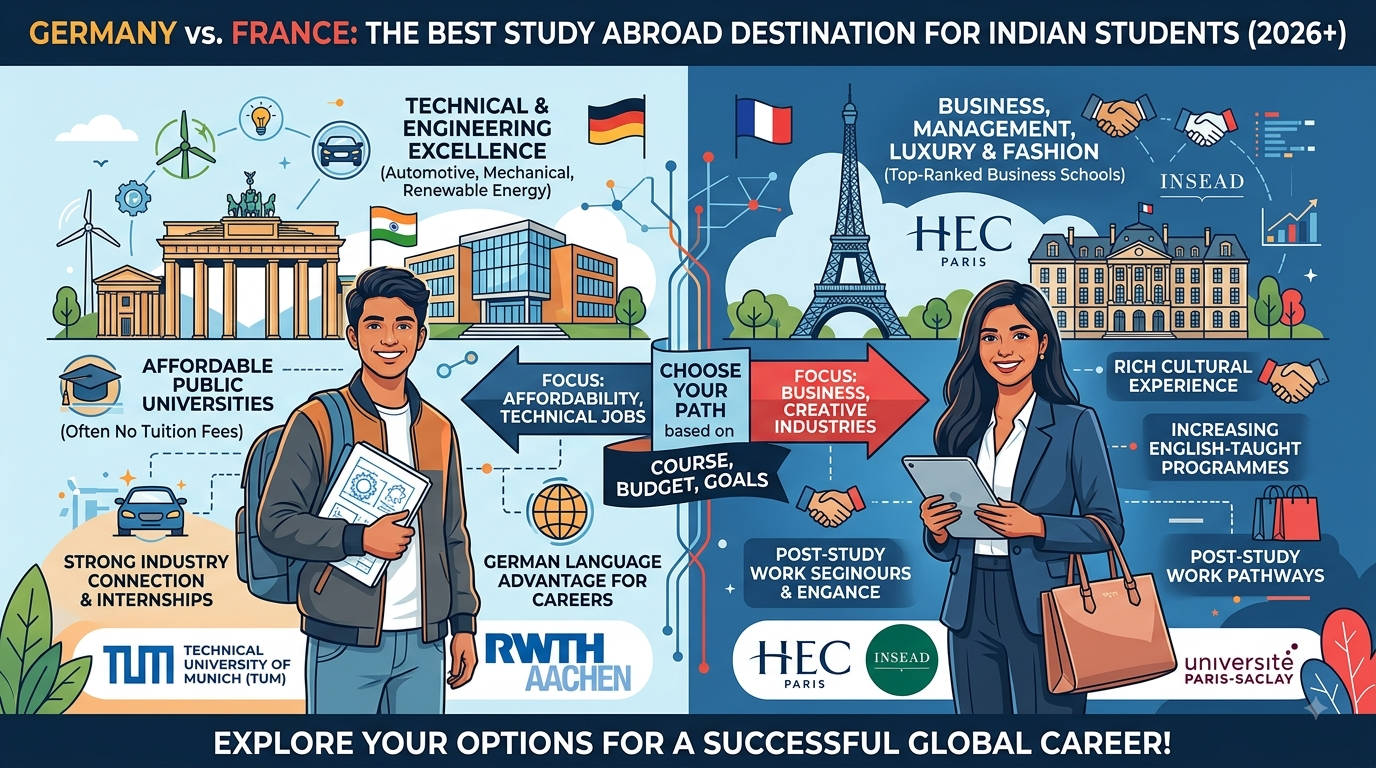
Germany is generally the better choice for Indian students looking for affordable technical education, engineering-focused programmes, and strong industry opportunities, while France can be a better option for students interested in business, management, luxury, fashion, hospitality, and specialised engineering. The right choice ultimately depends on your course, budget, language preferences, and career plans.
Germany and France are two of Europe's most attractive study destinations in 2026. Both offer internationally recognised universities, access to the European job market, and opportunities to experience life in a major European economy. Recent reporting also shows growing interest among Indian students in European destinations, including both Germany and France. (Reuters)
Is Germany or France cheaper for Indian students?
Germany usually has an advantage for students targeting public universities with low or no tuition fees, while France also remains relatively affordable compared with many English-speaking destinations.
In Germany, many public universities do not charge general tuition fees for bachelor's and many master's programmes, although there can be exceptions depending on the university, state, and programme. Students should therefore check the specific institution before applying.
France has introduced differentiated tuition fees for many non-EU students at public institutions. For the 2026–27 academic year, the published national rates are €2,902 per year for bachelor's programmes and €3,950 for master's programmes, although exemptions and institution-specific arrangements can apply. (Campus France)
Germany vs France: Tuition comparison
Factor | Germany | France |
|---|---|---|
Public university tuition | Often very low/no tuition, depending on institution | Differentiated fees for many non-EU students |
Bachelor's national public fee | Depends on university/state | €2,902 for many non-EU students |
Master's national public fee | Depends on university/state | €3,950 for many non-EU students |
Scholarships | Available | Available |
Private institutions | Can be expensive | Can be expensive |
Overall affordability | ⭐⭐⭐⭐⭐ | ⭐⭐⭐⭐ |
Winner: Germany, particularly for students who prioritise low tuition.
Which country has better universities?
Both Germany and France have internationally recognised universities and specialised institutions.
Popular universities in Germany
- Technical University of Munich (TUM)
- RWTH Aachen University
- Heidelberg University
- Humboldt University of Berlin
- Freie Universität Berlin
- Karlsruhe Institute of Technology
- TU Berlin
- University of Freiburg
Popular universities and institutions in France
- Université Paris-Saclay
- Sorbonne University
- Université Paris Cité
- Institut Polytechnique de Paris
- École Polytechnique
- CentraleSupélec
- Grenoble INP
- Université de Strasbourg
The choice should not be based only on the overall ranking. Course curriculum, specialisation, tuition, location, research facilities, internships, and industry connections can be more important for an individual student.
Is Germany better for engineering students?
Yes, Germany has a particularly strong advantage for engineering-focused students.
Germany is globally associated with automotive engineering, mechanical engineering, electrical engineering, industrial technology, manufacturing, automation, and renewable energy.
Indian students interested in fields such as:
- Mechanical Engineering
- Automotive Engineering
- Electrical Engineering
- Computer Science
- Mechatronics
- Industrial Engineering
- Renewable Energy
- Robotics
may find Germany especially attractive.
Germany's strong industrial ecosystem can also provide opportunities for internships, practical projects, and graduate employment.
Winner: Germany
Is France better for business and management students?
France can be an excellent choice for business and management.
The country has a strong ecosystem of business schools and major international companies. Paris is also one of Europe's important centres for finance, consulting, luxury, fashion, technology, and international business.
Students can consider:
- Business Management
- International Business
- Finance
- Marketing
- Luxury Management
- Hospitality
- Entrepreneurship
- Supply Chain Management
France can therefore be particularly attractive for students who want careers connected to business, luxury, hospitality, fashion, and management.
Winner: France for several business-oriented specialisations
Which country offers more English-taught programmes?
Both countries offer English-taught programmes, particularly at master's level.
Germany has a large selection of English-taught master's programmes, especially in engineering, technology, computer science, business, and science.
France also offers an increasing number of programmes taught in English, especially in business schools, engineering institutions, management, and postgraduate education.
However, students should not assume that every programme is available in English. Always check the official programme language before applying.
Do Indian students need to learn German or French?
Not necessarily for every course, but learning the local language can significantly improve your experience and career opportunities.
In Germany, an English-taught degree may allow students to study without German proficiency. However, German can be extremely useful when looking for internships, part-time jobs, and employment outside highly international workplaces.
The same applies to France. English-taught programmes exist, but French can make daily life and employment significantly easier.
Language comparison
Germany: English programmes + German language skills can improve employability.
France: English programmes + French language skills can improve employability.
Winner: Tie
Which country is better for part-time work?
Germany provides clear work provisions for international students. In 2026, students from third countries can work up to 140 full days or 280 half-days per year, with an alternative framework allowing up to 20 hours per week during lecture periods. (Make it in Germany)
France also allows international students to work under the conditions of their student residence status. Students should check the latest French government and Campus France requirements before planning their finances around part-time employment.
Students should remember that part-time work should supplement their finances, not be treated as the primary method of funding their education.
Winner: Germany
Which country has better post-study opportunities?
Both Germany and France can provide pathways for international graduates to continue their careers after graduation.
Germany has a particularly strong connection between higher education and industry. International graduates can remain in Germany when they meet the relevant requirements and secure appropriate employment. (Make it in Germany)
For Indian students targeting engineering, IT, manufacturing, automotive, energy, and technical careers, Germany can therefore be especially attractive.
France also offers opportunities across technology, business, engineering, luxury, finance, hospitality, and research.
However, post-study immigration rules can change, so students should always verify the latest requirements before making a decision.
Which country is better for Indian students in terms of cost of living?
The answer depends heavily on the city.
Large cities such as Munich, Berlin, Paris, and other major metropolitan areas can be considerably more expensive than smaller cities.
Students should calculate:
- Accommodation
- Food
- Transportation
- Health insurance
- Study materials
- Utilities
- Personal expenses
- Visa-related financial requirements
Germany requires students applying for a study visa to demonstrate sufficient financial resources. For 2026, the official German government portal states that a blocked account can require at least €11,904 for the year. (Make it in Germany)
The exact amount a student actually spends can vary according to location and lifestyle.
Which country is better for scholarships?
Both Germany and France offer scholarships and financial-support opportunities.
Indian students should explore:
- Government scholarships
- University scholarships
- Research funding
- Merit-based scholarships
- Need-based assistance
- Tuition-fee waivers
- Exchange programmes
France's public institutions can also offer tuition exemptions in certain circumstances. Campus France notes that institutions may grant exemptions to eligible international students, depending on their circumstances and institutional policies. (Campus France)
Germany vs France: Which is better for different courses?
Course/Field | Better Choice |
|---|---|
Mechanical Engineering | 🇩🇪 Germany |
Automotive Engineering | 🇩🇪 Germany |
Electrical Engineering | 🇩🇪 Germany |
Computer Science | 🇩🇪 Germany |
Robotics | 🇩🇪 Germany |
Renewable Energy | 🇩🇪 Germany |
Business Management | 🇫🇷 France |
Luxury Management | 🇫🇷 France |
Fashion | 🇫🇷 France |
Hospitality | 🇫🇷 France |
International Business | 🇫🇷 France |
Finance | 🇩🇪/🇫🇷 Both |
Data Science | 🇩🇪/🇫🇷 Both |
AI | 🇩🇪/🇫🇷 Both |
Which country is easier for Indian students?
There is no universal answer.
Germany can be attractive because of its relatively affordable public higher education and strong technical education. However, students may need to deal with documentation, university-specific admission requirements, financial proof, and sometimes German-language requirements.
France can be attractive because of its strong higher education ecosystem, business schools, engineering institutions, and growing international student environment.
For students applying to France from India, the Études en France (EEF) process is an important part of the application journey for applicable programmes. Campus France India announced that EEF fees would increase from INR 18,500 to INR 20,000 from August 1, 2026. (Campus France)
Germany vs France: Which has better career opportunities?
This depends heavily on the student's field.
Germany is particularly strong in:
- Automotive
- Engineering
- Manufacturing
- IT
- Robotics
- Automation
- Renewable Energy
- Industrial technology
France is particularly strong in:
- Luxury
- Fashion
- Hospitality
- Business
- Finance
- Aerospace
- Engineering
- Technology
- Tourism
Both countries have major international employers and access to the wider European market.
Which country is better for Indian students in 2026?
Germany is the stronger overall choice for many Indian students, particularly those interested in engineering, technology, computer science, manufacturing, and affordable public higher education.
France may be the better choice for students interested in business, management, luxury, fashion, hospitality, and certain engineering or technology specialisations.
Germany may be better if you:
- Want relatively affordable public education
- Plan to study engineering or technology
- Want strong industrial exposure
- Are willing to learn German
- Want to build a technical career in Europe
France may be better if you:
- Want to study business or management
- Are interested in luxury or fashion
- Want to study hospitality
- Are interested in French culture and language
- Prefer France's specialised business-school ecosystem
Blog Prepared By,
Jerin Francis
CEO & Abroad Study Advisor
Norvel Technologies Pvt Ltd